
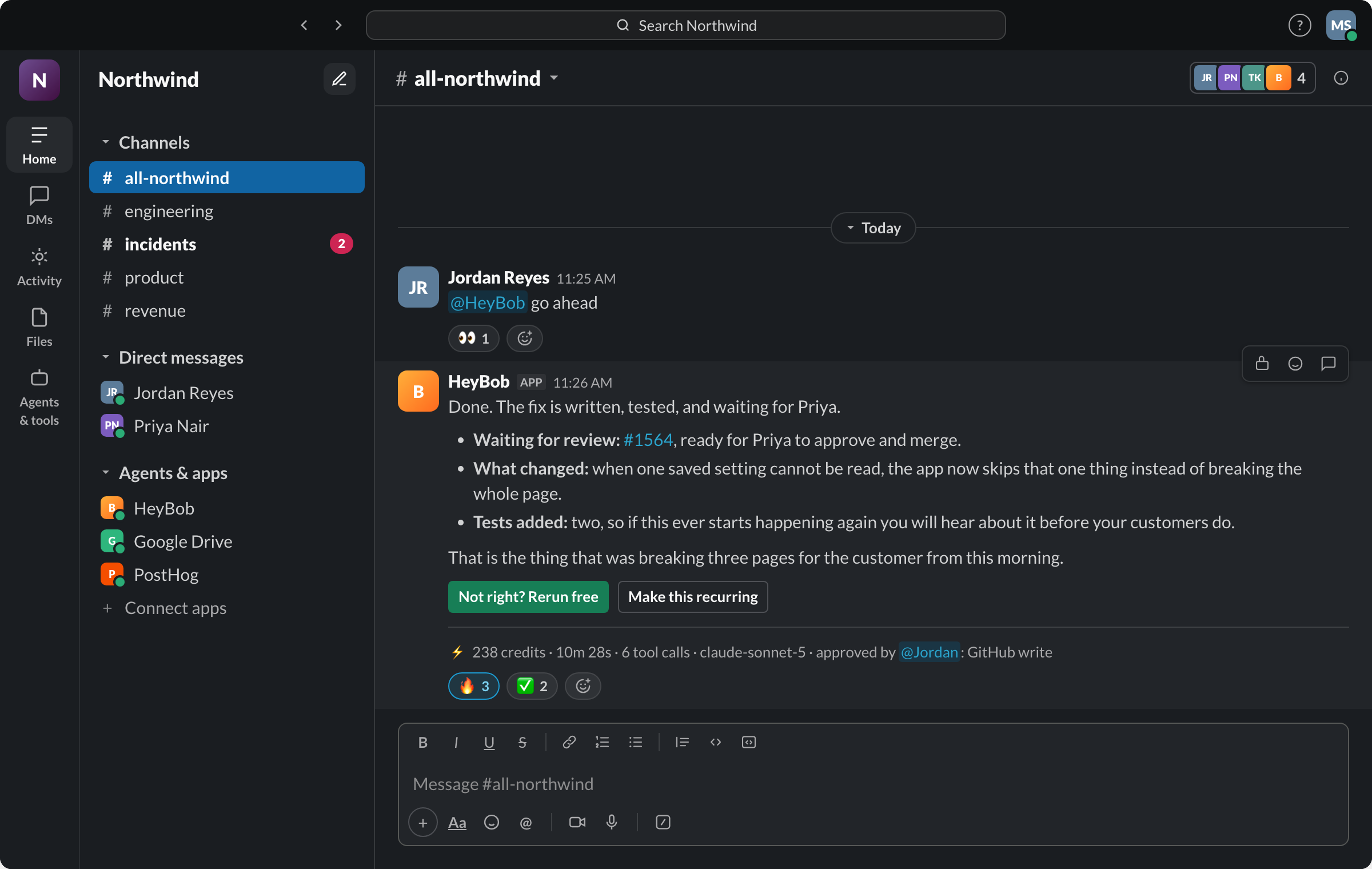
- Both put an autonomous AI employee inside Slack (Viktor's Microsoft Teams support is live; Bob's is in early access), one that finishes work, not one that drafts suggestions.
- Both connect to 3,200+ apps. App breadth is no longer the reason to choose between them.
- Viktor prices from $50/month for 20,000 shared credits, with a $100 no-card trial.
- Bob is built so you get value per credit, not so you spend more: a compact receipt on every completed run, hard workspace spend caps, free reruns when a run is Bob's fault, and Enterprise deployment inside your own VPC.
- If your last AI bill surprised you, the rows that matter below are receipts, spend caps, and free reruns.
What Viktor is
Viktor is an established product in this category. It runs an AI employee inside Slack and Microsoft Teams, connects to a published catalog of 3,200+ tools, and offers a $100 free trial with no card. Its public Team plan is $50/month for 20,000 shared workspace credits.
What Bob is
Bob connects to 3,200+ apps and works across them from Slack. Every run executes in its own sandboxed cloud computer, external writes pause for an Approve/Deny button by default, and every completed task posts a compact receipt with total credits, duration, and tool-call count. Workspaces can set a hard monthly spend cap with a warning at 80%, reruns caused by Bob's mistakes are free, and Enterprise customers can deploy Bob inside their own VPC.
What Bob connects to
An AI employee is only as useful as the systems it can reach. If the work lives in a tool Bob cannot open, you are back to copying and pasting, and the whole promise collapses. So the answer has to be boring and complete: Bob reaches 3,200+ apps, and connecting one takes a sentence in Slack and a sign-in.
Ask in the channel ("connect HubSpot"), Bob posts a Connect button, you sign in once on the hosted page, and that connection is ready for every run after it. Personal tools like Gmail, Google Calendar, HubSpot, and Linear connect per person, so a request runs against your row in the CRM and your inbox, under your own role, not a shared service account's.
| What your team runs | Apps Bob works in (examples) |
|---|---|
| CRM and pipeline | HubSpot, Salesforce, Pipedrive |
| Inbox and calendar | Gmail, Google Calendar, Microsoft Outlook |
| Docs and spreadsheets | Google Sheets, Google Drive, Notion, Microsoft Excel |
| Tickets and projects | Jira, Linear, Asana, ClickUp, monday |
| Support queues | Zendesk, Intercom, Front |
| Money and billing | Stripe, QuickBooks, Xero |
| Storefront | Shopify, WooCommerce, BigCommerce |
| Code and incidents | GitHub, GitLab, Sentry |
| Meetings and signatures | Zoom, Google Meet, Docusign, Calendly |
The catalog is the shortcut, not the ceiling. If your tool is not in it, Bob can work through its API, through an MCP server, or through the same browser your team uses, and for a core internal system we can build the connection. The full list is on the integrations page.
Whose side is your credit balance on?
Every product in this category charges by usage, so the vendor's revenue rises as your spend rises. That is not an accusation, it is simply how usage pricing works, and it means nothing about the product has to push your cost per task down.
Bob is built the other way around. The number we optimize is the value you get per credit, so we ship the parts that only make sense if we want your spend to fall: a receipt on every run so waste is visible the moment it happens, a hard monthly spend cap that you set and Bob will not cross, and free reruns when a run failed because Bob got it wrong. A vendor that wanted you to spend more would not hand you a cap and then eat the cost of its own mistakes.
Side by side
Which one should you pick?
Pick Viktor if…
- You need live Microsoft Teams support today.
- You want a $50 entry plan with 20,000 shared workspace credits.
Pick Bob if…
- You want a vendor whose pricing pushes your cost per task down, not up.
- You want the same 3,200+ app breadth with a receipt beside every finished task.
- You want a hard cap on monthly spend, enforced, not advisory.
- You need Bob deployed inside your own VPC.
- You'd rather onboard with the founder than a queue.
Either way: an AI employee in your channel beats a chatbot in a tab. The category is right; pick the accountability model you can live with.
Switching?
Early customers switching from another AI-employee platform get the credits remaining on their existing commitment matched, and Bob performs the migration itself during onboarding: it reads your recurring tasks and playbooks and rebuilds them in your workspace.
Fair questions
Is Bob a good Viktor alternative?
Yes. Both connect to 3,200+ apps and finish work from Slack. Viktor's Microsoft Teams support is live; Bob's is in early access. Bob is the stronger fit when you want compact per-run receipts, hard spend caps, free reruns, or an Enterprise deployment inside your own VPC.
How is Bob's pricing different from Viktor's?
Viktor's public Team plan is $50/month for 20,000 shared workspace credits. Bob starts at $99/month for 2,000 credits, with the per-1,000 rate improving as volume grows, and adds per-run receipts, one-month rollover, workspace spend caps, and volume changes that apply only at renewal, never mid-cycle. Enterprise pricing is custom and can include deployment inside your own VPC or use of your own model key.
Can I switch from Viktor to Bob?
Yes, see above. Credit match on your remaining commitment for early customers, and agent-led migration of your recurring tasks.
Does Bob support Microsoft Teams like Viktor does?
Both offer a Microsoft Teams surface. Viktor's Teams support is generally available; Bob's is in early access, and Slack is where Bob is most mature today.
Do Bob's credits expire?
Unused plan credits roll over one month before expiring, and one-off top-up packs never expire. Trial credits ($100 in value, no card required) last 14 days.
Viktor is a trademark of its respective owner. HeyBob and Bob are products of Tiny Cloud Ventures, which is not affiliated with, sponsored by, or endorsed by Viktor. This comparison is provided for informational purposes; details rechecked August 23, 2026 against Viktor’s public site.