Hand Bob the job. He comes back with it done.
He works in the apps you already use, then posts the finished result in the channel.
$100 of work, on us.No credit card. No sales call. 14 days to spend it.
He already knows your stack.


You do not wire anything up. You ask him to connect one, he sends the login link in the thread, and from then on it is his to use.
Bob takes the work you
keep pushing to tomorrow.
Four things a tool never does.
Software waits to be opened. A hire takes the job.
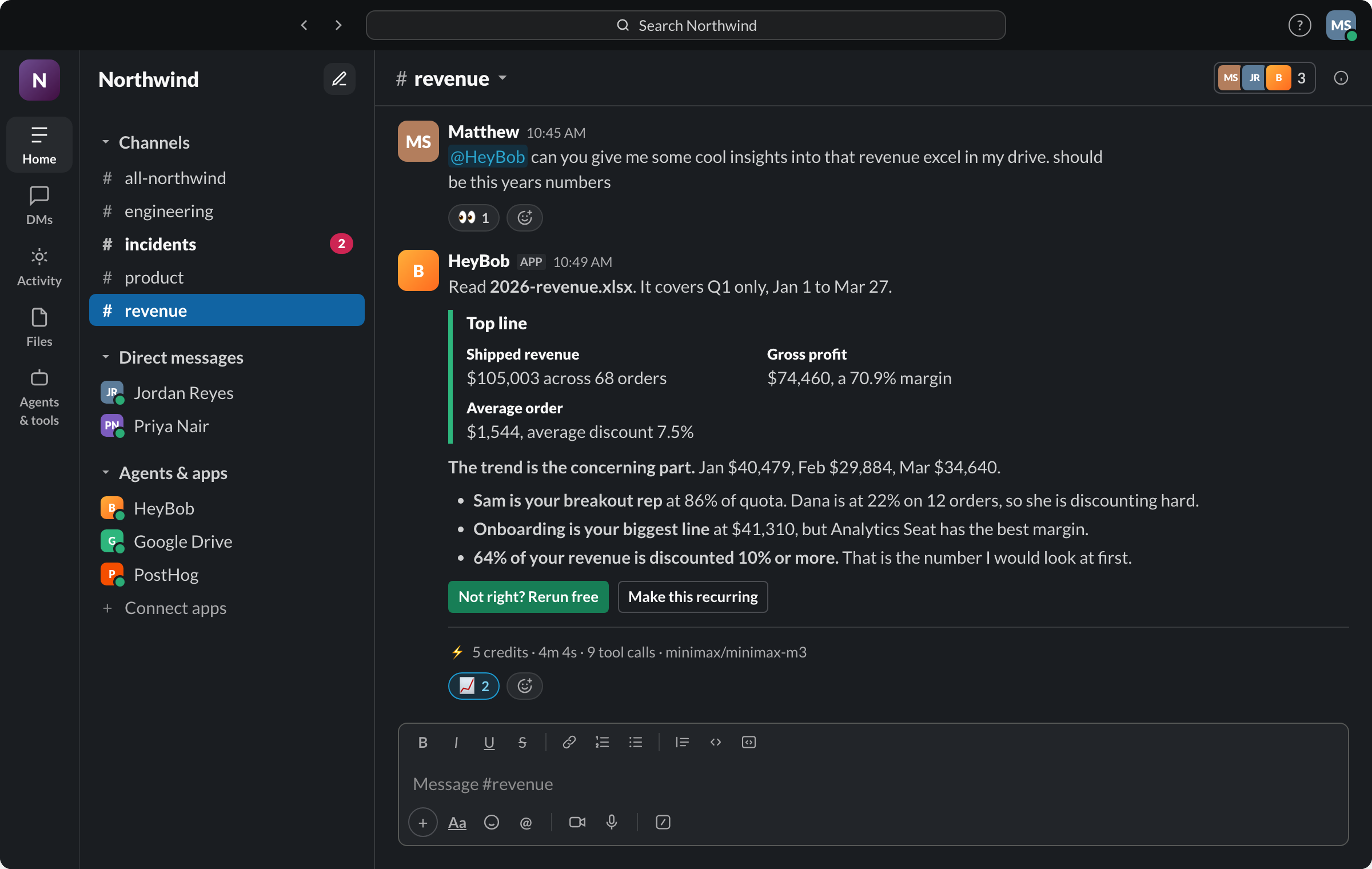
Done. Here is what your quarter says.
He finishes the job, not the first step
He opens the file, does the work in it, and comes back with the answer. Not instructions for you to follow.
Google Drive connected. Mine to use now.

One message, your whole stack
Three thousand two hundred apps he can sign into. You ask him to connect one, he sends the link in the thread.
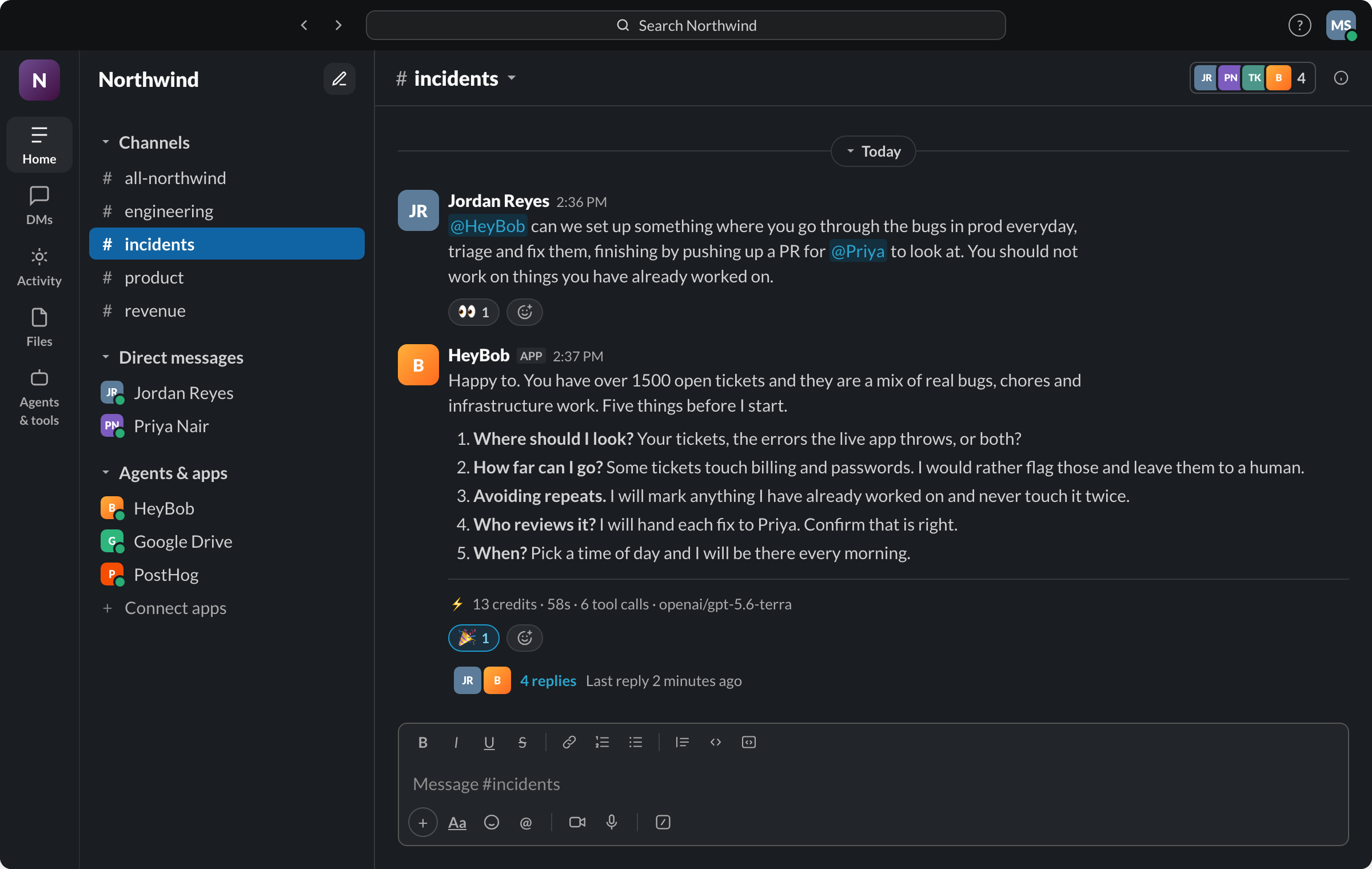
Scheduled. It happens without you now.
He works the hours you do not
Two clicks under any finished run and it happens again on its own, every week, without you asking.
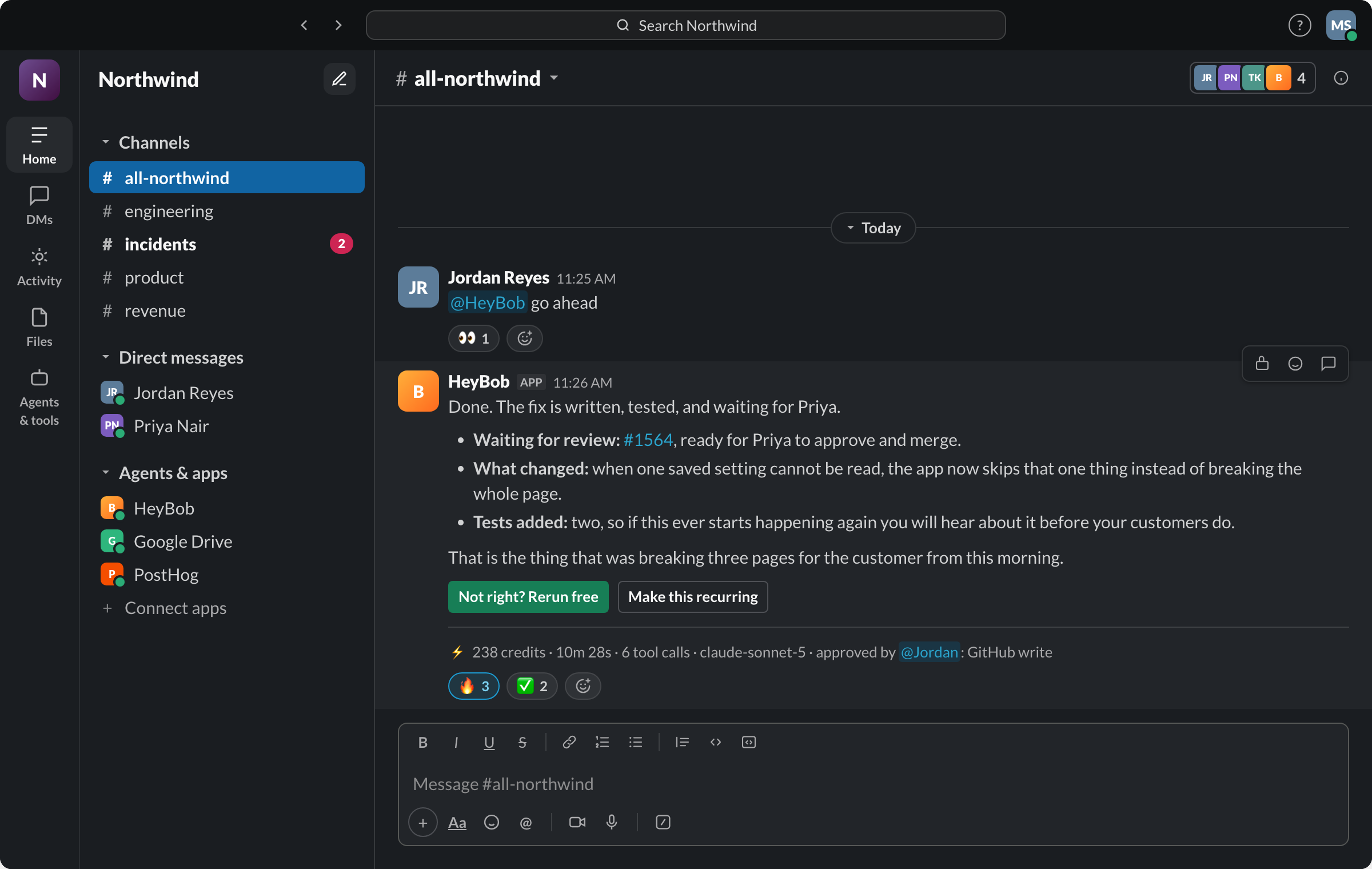
Finished. Here is what it cost you.
He shows his work, every time
A receipt under every run, in the channel. What it cost, how long, what he touched, and who approved it.
The work you keep redoing is a job description.
“I could do that myself in twenty minutes.” You can. You will also do it again next week.
How often should I do this?
Say it in plain language, like “every Tuesday at 4pm” or “every weekday at 8am”.
Two clicks under any finished run. No cron, no builder, no automation tab.
Senior time on junior work
The Monday report. The deck. The follow-ups. First-year work, done by the most expensive person in the building.
The handoff
Someone asks. Someone says Thursday. The deadline is Wednesday. Two days lost to nobody’s real job.
The work that needs judgment waits
The pricing call. The hire. The customer drifting away. Chores have deadlines. Judgment does not.
Write down what you did last week and will do again next week. That is his job description.
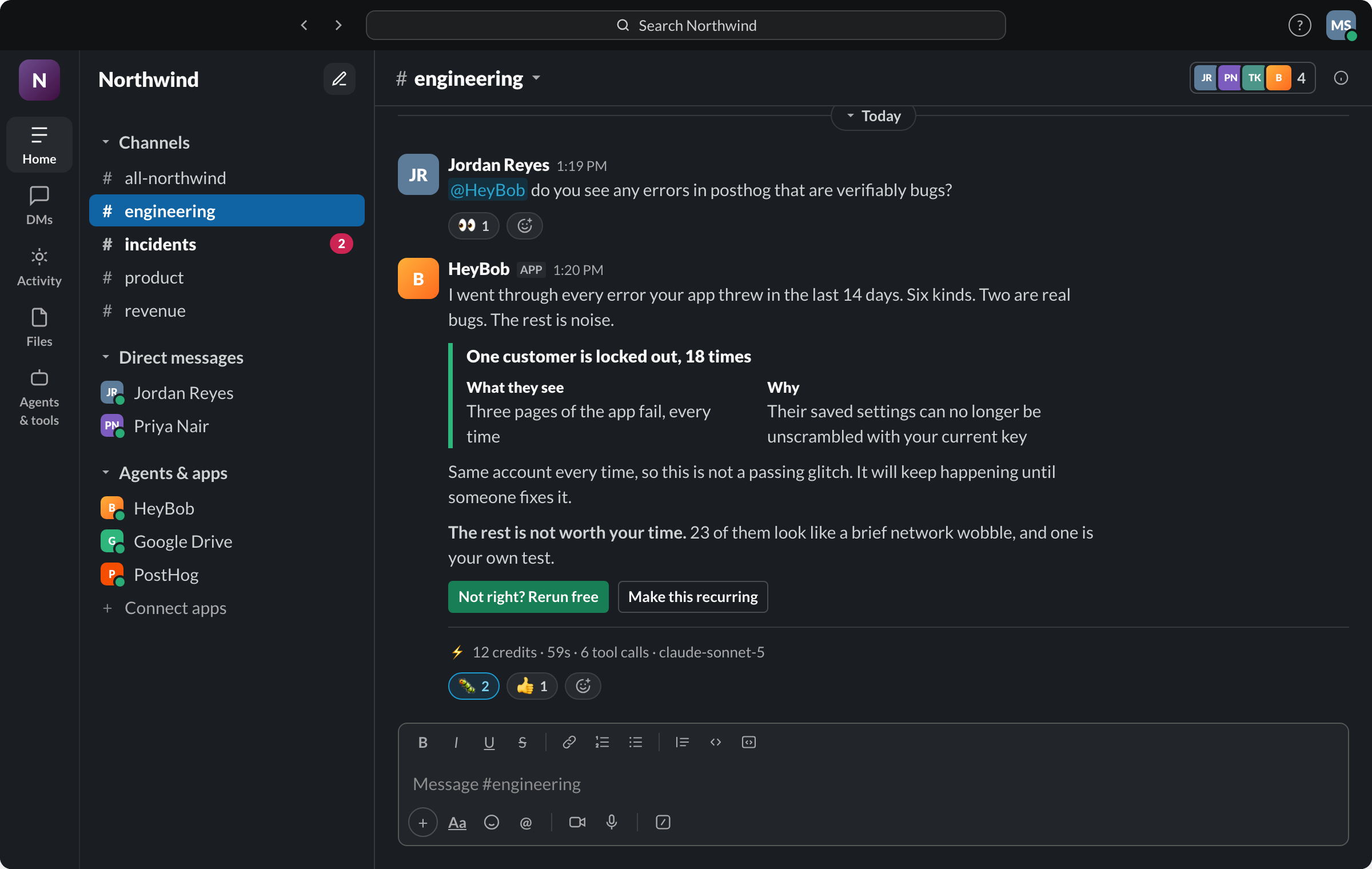
Advice is cheap. Doing the job is the job.
“I’ll just use ChatGPT or Claude.” A chat explains reconciliation beautifully. You still open QuickBooks yourself.
If your team already pays for Claude Team, its Slack teammate is good. Bob is for everyone else, and for anyone who wants the cost before the invoice.
You scope him once, the way you would a new hire.
“I’m not letting an AI loose in my tools.” Neither would we. Reads are reads. Writes wait for you.
This line sits under every finished run, in the channel, where the whole team can read it. It is copied here verbatim from a production run, not redrawn.
Per tool, per action
You decide what is automatic. The decision stays in the thread, so the channel sees who approved what.
A receipt beside the work
Cost and time on every run. Ask what ran this week and he tells you.
A cap he will not cross
Set a monthly ceiling. He stops at it.
Verify it: ask him to change a record. Watch him wait. Deny it.
His first day takes five minutes.
No project, no onboarding call. Three steps, and the third is real work.
Add Bob to Slack
One click. Slack lists every permission, and an admin has to say yes.
Connect a tool by asking
Type it in the channel. Sign in once, on that tool’s own page.
Hand him one real job
Not a demo task. Something off last week’s list.
Five minutes in, you have finished work and a receipt. Not a trial account.
One flat price for the whole team
$99 a month per workspace. No per-seat fees. First $100 free for 14 days, no card.
The questions people actually ask.
Everything below is how Bob behaves today, not a roadmap.
What is Bob, exactly?
An AI employee that lives in Slack, with Microsoft Teams in early access. He has his own sandboxed computer in the cloud, uses your connected tools, and browses the web to finish real work, then reports back in the channel with the result and a receipt. Not a chatbot; a coworker with paperwork.
Will Bob touch my CRM without asking?
No. External writes pause for an Approve/Deny button by default. You decide, per tool and per action, what’s automatic and what needs a human tap, and the decision stays visible in the Slack thread.
Can Bob do things on a schedule?
Yes, just tell him. ’Post the pipeline summary every weekday at 7:30’ is enough; no cron syntax, no dashboard. He confirms the schedule in plain English with the next run time, and pausing, resuming, or cancelling it is just as conversational. Any completed task also gets a ’Make this recurring’ button if you’d rather not type it out.
Will scheduled tasks spam my channel?
No. A check-in that finds nothing worth saying posts nothing, with no “no updates“ noise. The receipt still exists: ask what ran this week and Bob reports every firing, what it found or why it stayed quiet, and what each one cost. You can set quiet hours per schedule, and if a schedule fails repeatedly, Bob pauses it and tells you why instead of continuing to run a broken task.
Can Bob react to things outside Slack?
Yes. Ask Bob for a webhook and he hands you a URL. Point any system at it and Bob acts when it fires: “when a ticket closes, tell the channel.“ Same rule as scheduled runs: he only posts when the event is actually worth mentioning.
Does Bob learn our preferences?
Yes, and over time, two ways. Workspace memory holds the definitions, decisions, and conventions your team has already agreed on, so every run starts with the context that doesn’t need re-explaining. Per-user memory holds each person’s individual working style: how YOU like summaries, what shortcuts YOU take, which Slack threads YOU want skimmed, so the next run by the same person picks up where the last one left off. Both are inspectable and editable; neither is used to train anyone else’s model.
Do my credits expire?
Paid-plan credits roll over for one month, then expire. Trial credits expire after 14 days. Purchased top-up packs do not expire.
Can we bring our own API keys?
Yes, self-serve. The BYOK tier is $349/month: paste your Anthropic and OpenAI keys in workspace settings and Bob’s runs execute on them, so the token bill goes straight to your provider at your rates. Platform credits burn at one fifth the managed rate with a 20,000-credit monthly allowance and top-up packs past it. Enterprise adds VPC deployment at custom pricing.
How do I know what a task cost me?
Every completed run ends with a compact receipt showing total credits, duration, and tool-call count.
Can Bob’s answers be wrong?
Yes. Bob is powered by large language models, and like any AI he can make mistakes: responses may occasionally be inaccurate, incomplete, or out of date, so review Bob’s work before relying on it. Every run ships with a receipt and an audit log, writes pause for approval by default, and reruns on Bob’s mistakes are free.
What if Bob makes a mistake?
If Bob gets a run wrong, you can rerun that task once without being charged for the redo. Each original run can receive one no-charge rerun, up to 10 per workspace in any rolling 30-day period. Risky writes still wait on approval, and the receipt shows what the original run cost.
Can I run Bob in my own cloud?
Yes. The Enterprise tier ships as containers for your own VPC, with offline license verification that degrades gracefully: an expired license stops new runs, it never bricks your deployment.
Bob is powered by large language models and, like any AI, can produce inaccurate, incomplete, or out-of-date responses. Review Bob’s work before relying on it.
Give him something to do today.
One job off last week’s list. If he gets it wrong, you lost ten minutes.