
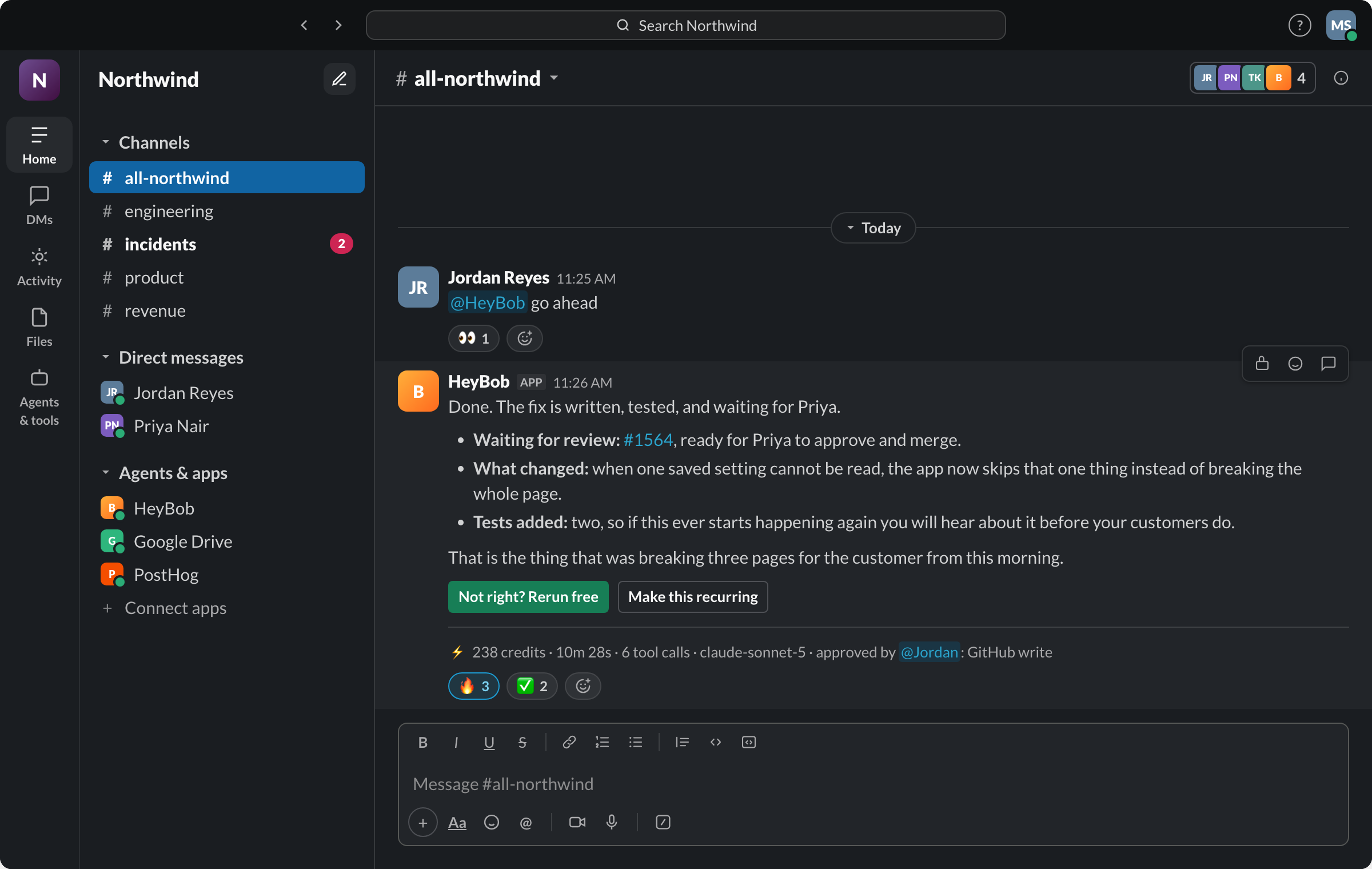
- Both connect an AI agent to thousands of apps and finish real work rather than drafting suggestions.
- Tasklet's home base is its own web and desktop app, organized as threads; Slack, Telegram, and Microsoft Teams are connected trigger and posting channels, not the primary place you work with an agent.
- Bob's home is Slack itself, with Microsoft Teams in early access.
- Tasklet documents 14 trigger types and natural-language scheduling, plus built-in image and video generation.
- Bob posts a compact receipt on every completed run, gates external writes behind approval by default, and lets a workspace set a hard monthly spend cap with an 80% warning.
What Tasklet is
Tasklet is an AI agent platform built around threads: private conversations with individual agents in Tasklet's web and desktop app. It connects to 3,000+ built-in integrations, plus any HTTP API or MCP server, and can fall back to a built-in browser when no integration exists. Agents run inside a Linux VM sandbox with a persistent per-thread filesystem and SQL database, its v2 architecture can spin up subagents for complex work, and it supports 14 trigger types, including schedules described in plain language, webhooks, RSS feeds, email, and messages in Slack, Telegram, and Microsoft Teams. Plans run from a free tier with 300 daily bonus credits to a Custom plan from $250/month with 100,000+ monthly credits.
What Bob is
Bob connects to 3,200+ apps and works across them from Slack, with Microsoft Teams in early access. Every run executes in its own sandboxed cloud computer, external writes pause for an Approve/Deny button by default, and every completed task posts a compact receipt with total credits, duration, and tool-call count. Workspaces can set a hard monthly spend cap with a warning at 80%, reruns caused by Bob's mistakes are free, and Enterprise customers can deploy Bob inside their own VPC.
What Bob connects to
An AI employee is only as useful as the systems it can reach. If the work lives in a tool Bob cannot open, you are back to copying and pasting, and the whole promise collapses. So the answer has to be boring and complete: Bob reaches 3,200+ apps, and connecting one takes a sentence in Slack and a sign-in.
Ask in the channel ("connect HubSpot"), Bob posts a Connect button, you sign in once on the hosted page, and that connection is ready for every run after it. Personal tools like Gmail, Google Calendar, HubSpot, and Linear connect per person, so a request runs against your row in the CRM and your inbox, under your own role, not a shared service account's.
| What your team runs | Apps Bob works in (examples) |
|---|---|
| CRM and pipeline | HubSpot, Salesforce, Pipedrive |
| Inbox and calendar | Gmail, Google Calendar, Microsoft Outlook |
| Docs and spreadsheets | Google Sheets, Google Drive, Notion, Microsoft Excel |
| Tickets and projects | Jira, Linear, Asana, ClickUp, monday |
| Support queues | Zendesk, Intercom, Front |
| Money and billing | Stripe, QuickBooks, Xero |
| Storefront | Shopify, WooCommerce, BigCommerce |
| Code and incidents | GitHub, GitLab, Sentry |
| Meetings and signatures | Zoom, Google Meet, Docusign, Calendly |
The catalog is the shortcut, not the ceiling. If your tool is not in it, Bob can work through its API, through an MCP server, or through the same browser your team uses, and for a core internal system we can build the connection. The full list is on the integrations page.
Whose side is your credit balance on?
Every product in this category charges by usage, so the vendor's revenue rises as your spend rises. That is not an accusation, it is simply how usage pricing works, and it means nothing about the product has to push your cost per task down.
Tasklet's answer to cost control is Tasklet for Teams: centralized billing with usage limits set per member and per agent. That is a real lever, but it is a limit you configure per person and per agent, not a single workspace-wide ceiling with a warning before you hit it, and Tasklet's own pricing page says monthly credits reset each billing cycle rather than rolling over. Bob is built the other way around: a receipt on every run so waste is visible the moment it happens, one hard monthly spend cap for the whole workspace with an 80% warning, unused credits that roll over a month, and free reruns when a run failed because Bob got it wrong.
Side by side
Which one should you pick?
Pick Tasklet if…
- You want natural-language scheduling across a wide trigger list, including RSS, iMessage, Telegram, and Apple Shortcuts.
- You want an agent that generates images and short videos with audio directly.
- You want a low-cost entry plan starting at $25/month.
- Your team's home base is a dashboard of threads, not a Slack channel.
Pick Bob if…
- You want Slack, or Teams in early access, to be the actual place the work happens, not a channel it posts summaries into.
- You want a receipt with every completed run instead of piecing cost together from an intelligence-level setting.
- You want one hard workspace-wide spend cap with a warning before you hit it.
- You want writes gated behind approval by default, not opt-in per connector.
- You need Bob deployed inside your own VPC.
Either way: an AI employee that finishes the job beats a dashboard of automations you have to check on. The category is right; pick the interface and the cost controls you can live with.
Switching?
Early customers switching from another AI-employee platform get the credits remaining on their existing commitment matched, and Bob performs the migration itself during onboarding: it reads your recurring tasks and playbooks and rebuilds them in your workspace.
Fair questions
Is Bob a good Tasklet alternative?
Yes, if the work is supposed to happen in Slack. Tasklet's home base is its own web and desktop app, with Slack, Telegram, and Microsoft Teams as connected trigger and posting channels. Bob's home is Slack itself, with Teams in early access, and every completed run posts a compact receipt and pauses for approval before external writes by default.
How is Bob's pricing different from Tasklet's?
Tasklet runs a free plan with 300 daily bonus credits, then Starter at $25/month for 10,000 credits, Pro at $100/month for 40,000 credits, and Custom from $250/month for 100,000+ credits; credits reset each billing cycle rather than rolling over. Bob starts at $99/month for 2,000 credits, with the per-1,000 rate improving as volume grows, unused plan credits roll over one month, and every plan includes per-run receipts and a workspace spend cap. Enterprise pricing is custom for both.
Does Bob support the same trigger types as Tasklet?
Not the same list. Tasklet documents 14 trigger types, including RSS feeds, iMessage, Telegram, and Apple Shortcuts alongside schedules, webhooks, and email. Bob starts a job from a mention or DM, a schedule described in plain words, an incoming webhook, or a dedicated inbound email address.
Can I switch from Tasklet to Bob?
Yes, see above. Credit match on your remaining commitment for early customers, and agent-led migration of your recurring tasks.
Do Bob's credits expire?
Unused plan credits roll over one month before expiring, and one-off top-up packs never expire. Trial credits ($100 in value, no card required) last 14 days.
Tasklet is a trademark of its respective owner. HeyBob and Bob are products of Tiny Cloud Ventures, which is not affiliated with, sponsored by, or endorsed by Tasklet. This comparison is provided for informational purposes; details rechecked August 23, 2026 against Tasklet’s public site.